.png)
Where does Bellevue's lunch come from?
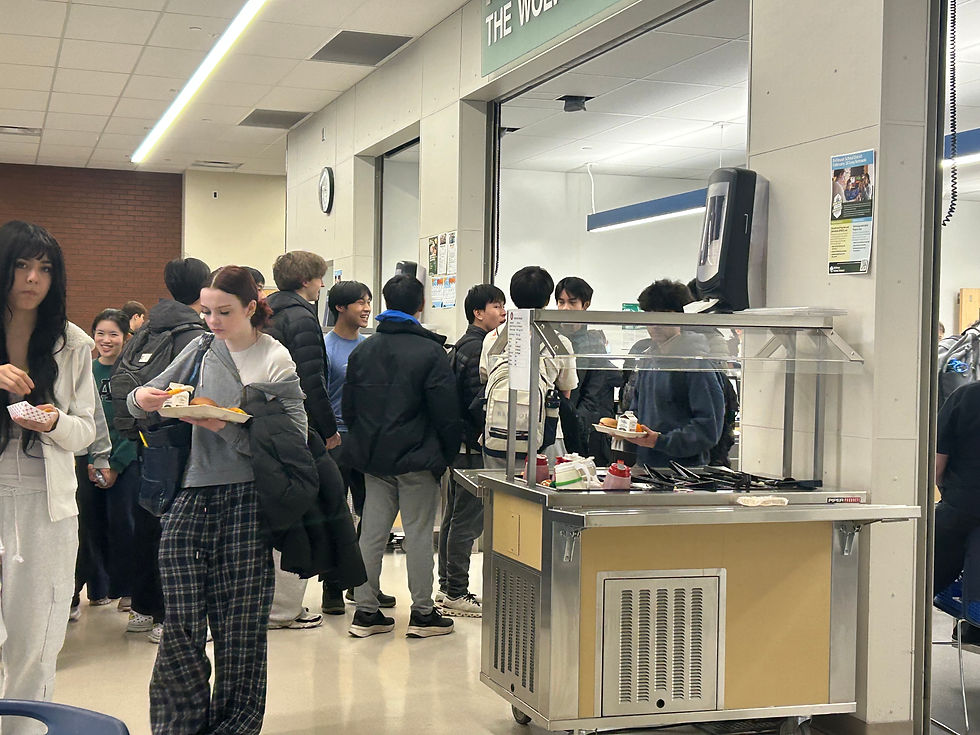
A lazy electronic chime is all that indicates the 11:40 AM opening of one of Bellevue’s most storied culinary institutions. A horde of hungry teens beckons its call, morphing itself into several lines which lazily snake around wooden sitting tables and block pedestrian traffic. Those in the longest queue patiently wait for today’s lunch special, while others, in an adjacent but much shorter line, are craving a slice of pizza.
Nowadays, the Bellevue High School (BHS) cafeteria serves an average of nearly 600 meals per school day. Yet despite the fact that most patrons are repeat visitors, few diners appear aware of where their food comes from.
“I usually eat school lunches because it’s easy and saves time…I usually rotate through the dish of the day…I actually have no idea where the food comes from and…where it gets shipped from,” junior Lyalla Magsi said.
The fact that BHS students—myself included—consume food multiple times a week without knowing where it comes from begs the question: how exactly do school lunches find their way onto our plates?
The first step in the journey from farm to plate starts with cook manager Peggie Shing, who orders provisions from Bellevue School District (BSD)’s four major suppliers based on the upcoming lunch menu (Shing also supplied much of the following information). Food service distributor US Foods supplies typical American staples such as burgers and pizza, as well as other items like pinto beans and tortilla chips. Fresh fruits or vegetables come from Charlie’s Produce, a food distributor whose trucks you’ve likely seen roaming Bellevue. Milk is provided by Smith Brothers Farms, a dairy distributor based in Kent, WA, which sources its products “directly from family farmers in Washington and Oregon,” and bread items, like hamburger buns or sub rolls, come from Franz Bakery. All four distributors deliver to BHS on a weekly basis. Additional supplies also arrive from the district warehouse every Thursday. These supplies include basic ingredients, like sauces, as well as pre-cooked meals, such as the green chili bean & cheese burritos.
A quick digression: ideally, we would be able to trace individual items, such as turkey sausages or nachos, back to their respective farms or factories. But take, for instance, the beef patties that US Foods supplies. Any one of these patties could come from one of the thousands of individual suppliers that US Foods sources from. Even our most local distributor, Smith Brothers Farms, ended production of their own milk in 2006 by selling their cow herd to focus solely on distribution. Unfortunately, tracking food along the entire supply chain is nearly impossible.
Apart from snacks like chips, the first destination of food upon arrival at BHS is either the fridge or freezer, both of which are industrial-sized, easy to walk into and feature strict temperature regulations. When a certain food item is to be used for lunch, it’s first defrosted in the morning by Shing (who simultaneously prepares breakfast). The other three members of Shing’s lunch team arrive at school around 10:00 AM, at which point—with all the ingredients defrosted and ready for assembly—real meal preparation begins in earnest.
I say “meal preparation” because, apart from pizza, all the food that arrives to BHS has already been cooked. However, as a safety precaution, all food at risk of carrying foodborne pathogens (e.g. burger patties) must be heated up to at least 165°F before being consumed.
Once Shing’s team arrives at school (again, at 10:00), each member of the team is assigned a role: one is responsible for making burgers, another cooks the pizza, a third takes charge of the salad bar, and Shing assembles the main entrees. Food is assembled—remember, it’s all already cooked—in giant trays and stacked in an industrial warmer to kill pathogens and keep it warm until consumption. After an hour-and-a-half long meal prep frenzy, all 600 meals are ready to go. The lunch counters are cleared, food is displayed and Shing’s team takes their positions along the lunch aisle. Finally, the 11:40 bell rings, and a morning’s labor worth of food is rapidly consumed, often without much consideration from the diners. So the next time you eat a school lunch, consider the process and labor involved in its creation. Just some food for thought.


